Concrete that arrives with high initial slump can still become difficult to place before the pour is complete. You will learn how to measure flow over time, run a controlled PCE dosage trial, adjust the addition sequence, and identify when higher flow is creating stability or setting problems.
Key takeaways
- Use slump and slump-loss checks to separate initial flow from retention.
- Run dosage trials with your cement, aggregates, temperature, and delivery time.
- Control PCE addition by measured batch quantities, not a supplier range alone.
- Qualify the mix before production, pumping, and final placement.
How PCE Creates Flow—and Why Slump Retention Is a Separate Test
PCE increases concrete flow without adding mixing water through electrosteric dispersion. Its anionic backbone adsorbs onto cement particles, while attached side chains push neighbouring particles apart through steric repulsion. The cement flocculates less, trapped water becomes available for lubrication, and the mix flows at the same water content.
PCE dispersion is not identical across products. Polymer architecture and adsorption speed can produce different initial slump, water reduction, and retention even when two products have similar solids content. A retention-focused PCE may deliver less immediate flow but hold workable consistency longer.
| Measurement | What it shows | What to record |
|---|---|---|
| Initial slump | Vertical consistency immediately after mixing | Slump in millimetres, mix temperature, dosage, and test time |
| Slump flow | Spread of a high-flow or self-consolidating mix | Average spread diameter in millimetres; include the slump flow baseline measurement |
| Slump retention | Workability available during transport and placement | Initial value, then values at defined elapsed times such as 30, 60, and 90 minutes |
Do not treat a high initial slump as proof of retention. A mix can start fluid and lose placement flow quickly, while another starts lower and remains usable. Record the same test, temperature, mixing history, and elapsed time at every checkpoint; otherwise, the comparison cannot distinguish PCE performance from handling variation.
A Field Procedure for Measuring Slump and Controlling PCE Addition
Set the target at the point of placement, not at the mixer: record the required slump, discharge temperature, delivery time, and maximum placement time. For self-consolidating concrete, use slump flow under ASTM C1611 instead of treating a conventional slump value as the acceptance target.
1. Make a baseline batch with the planned cement, supplementary cementitious materials, aggregates, water, and air-entraining admixture. Measure slump immediately after mixing, then repeat at the planned placement time and at 30, 60, or 90 minutes. Record air content, concrete temperature, setting behavior, bleeding, and visual segregation.
2. Select the PCE dosage from a controlled trial, then calculate the batch quantity from the product’s stated density or solids content. Do not compensate for clay-bearing sand by continually increasing PCE; clay can adsorb the polymer and destroy slump retention.
3. Keep the PCE addition sequence constant across trials. Use the plant’s actual mixer and aggregate moisture condition.
| Addition point | Benefit | Risk or control |
|---|---|---|
| With initial batch water | Simple dosing | Poorly wetted materials can disperse the PCE unevenly |
| After partial wetting | Better contact with a hydrated cement system | Requires a consistent delay and mixing time |
| Late adjustment | Restores measured slump near placement | Validate setting, air, and uniformity before use |
After adding PCE, mix for the validated mixing time, then repeat the slump test. Compare the result with the target and check air, temperature, bleeding, and segregation. Recheck at the maximum placement time: initial slump alone does not prove slump retention.
Run a Dosage Trial Instead of Guessing from a Supplier Range
A supplier range is a starting boundary, not a mix design. Run a PCE dosage trial with the actual cement, supplementary cementitious materials, aggregates, water, air-entraining admixture, concrete temperature, and planned delivery interval. Cement chemistry can shift the response, so two mixes receiving the same percentage may produce different initial slump and slump retention.
- Choose three or four trial levels within the supplier’s stated range, such as 0.60%, 0.80%, 1.00%, and 1.20% of cementitious materials mass. Confirm whether the percentage refers to the liquid product, dry solids, or active polymer.
- Mix each batch using the approved sequence and mixing time. Record slump or slump flow at discharge and at the planned placement limit, such as 60 or 90 minutes.
- Reject a level that reaches flow by causing excessive air, bleeding, segregation, setting delay, or poor visual stability.
- Select the lowest dosage that meets the required flow at discharge and at the endpoint, with a practical margin for normal batching variation.
For dosage calculation, multiply the selected percentage by cementitious materials mass. A 0.80% dosage in concrete containing 400 kilograms per cubic metre requires 3.2 kilograms of product per cubic metre. If the product density is 1.05 kilograms per litre, calculate 3.2 ÷ 1.05 = 3.05 litres per cubic metre.
Use the supplier’s stated density and dosage basis rather than assuming one litre equals one kilogram.
Match the PCE to Cement, Aggregates, Temperature, and Delivery Time
Slump loss is driven by cement chemistry, aggregate condition, concrete temperature, and the time between mixing and placement—not by PCE dosage alone. Sulfate availability, aluminate reactivity, alkali content, cement fineness, and supplementary cementitious materials change polymer adsorption, so two cements can produce different slump retention at the same dose.
| Variable | How it causes slump loss | What to check or change |
|---|---|---|
| Cement chemistry | Fast adsorption or hydration consumes dispersing capacity | Trial the actual cement and SCM combination; record slump at discharge and planned placement time |
| Clay-bearing sand | Clay adsorbs or intercalates PCE, leaving less active polymer | Test sand cleanliness and clay content; use clay-tolerant PCE or a clay-control strategy before increasing the main dose |
| Aggregate moisture | Incorrect free-water calculation changes the effective water-cement ratio | Apply aggregate moisture correction for every stockpile and rain condition |
| Temperature and delivery time | Higher concrete temperature accelerates hydration and shortens the usable placement window | Run trials at the expected temperature and maximum delivery interval, not only at laboratory temperature |
Increasing PCE can recover flow until the cement and aggregate system reaches adequate dispersion. Beyond that point, more product can delay setting, increase bleeding, segregation, or air entrainment. Excess dosage can also reduce pumping consistency.
Select the dose through a materials-specific trial, and use a viscosity-modifying admixture only when stability remains poor; it can increase viscosity and reduce spread.
Qualify the Mix Before Production and Placement
Approve a PCE only after PCE compatibility testing uses the actual cement, supplementary cementitious materials, aggregates, mixing water, and air-entraining admixture. A water-reduction result alone cannot predict flow retention in production.
1. Prepare trial batches at the expected concrete temperature, dosage, mixing sequence, and delivery interval. Record slump or slump flow at discharge and again at the planned maximum placement time, such as 60 or 90 minutes.
2. Use ASTM C1611 when the mix targets self-consolidating or highly flowable concrete. Record spread diameter, T500 time if relevant, and visual stability; watch for paste separation, aggregate settlement, or a mortar ring. For ordinary plastic concrete, use the conventional slump test.
3. Measure air content, concrete temperature, setting time, bleeding, and compressive strength. Compare each result with the project specification and the control mix, because extra PCE can delay setting, increase air, or reduce stability even when the initial flow looks excellent.
4. Request the supplier’s recommended dosage range, addition sequence, minimum mixing time, density or solids information, storage limits, batch traceability, and known incompatibilities. Ask how the product behaves with your cement and air-entraining admixture.
For a product under consideration from Wizplast Chemicals Pvt. Ltd., require a project-specific trial rather than selecting a grade from its name alone. Approve the mix only when initial flow, retention, visual stability, air content setting time bleeding compressive strength all remain acceptable.
Related products
 | PCE Based Admixture WIZPLAST - 833 SC is a high-performance PCE (Polycarboxylate Ether) based admixture, specially formulated to enhance the workability, durability, and... View product → |
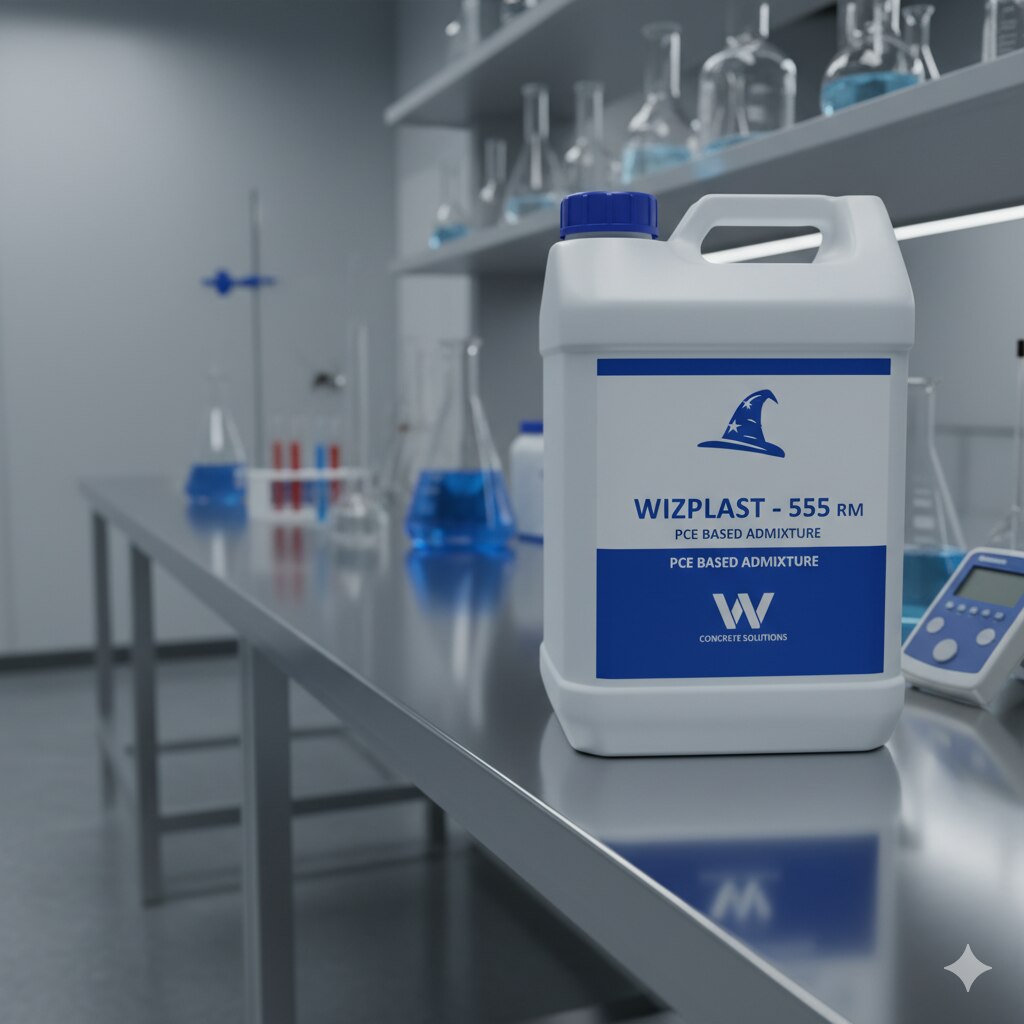 | PCE Based Admixture developed by Wizplast Chemicals Pvt. Ltd., is a high-performance PCE (Polycarboxylate Ether) based concrete admixture designed to enhance the quality... View product → |
Frequently asked questions
How does PCE improve concrete flow without adding water?
PCE adsorbs onto cement particles and uses electrosteric dispersion to reduce flocculation, releasing trapped water for lubrication.
Why is slump retention a separate test from initial slump?
Initial slump measures flow after mixing, while slump-retention checks show how much flow remains after elapsed delivery or placement time.
How should you set the dosage of a PCE admixture?
Run dosage trials using the actual cement, aggregates, water content, mixing sequence, and target delivery time instead of guessing from a supplier range.
What must you check before using a PCE mix in production?
Qualify the mix for flow, slump loss, setting behaviour, finishing, pumping, and placement under the expected site conditions.
Related product
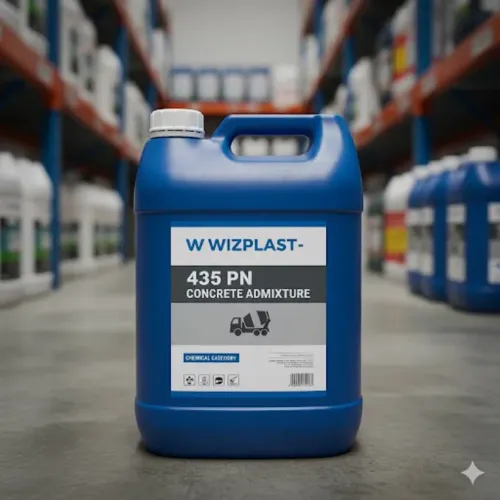
 | PCE Based Admixture WIZPLAST-435 PN is a high-performance PCE (Polycarboxylate Ether) based concrete admixture designed to enhance the workability and durability of... View product → |