A concrete admixture improves performance only when its dosage, addition sequence and compatibility match the actual cementitious system and site conditions. By the end, you will know how to compare mixes at equal slump, select a starting dosage, run a meaningful trial batch and detect problems before placement.
Key takeaways
- Disperse cement particles to improve flow without adding mixing water.
- Match admixture type and dosage to slump, temperature and placement conditions.
- Use trial mixes to verify water reduction, setting time and cement compatibility.
- Treat admixtures as performance tools, not substitutes for curing and quality control.
How particle dispersion improves workability without adding water
Concrete becomes easier to place when cement particles stop clumping together. Particle flocculation traps part of the mixing water inside irregular clusters, leaving less free water to lubricate cement paste and aggregate.
A water reducer adsorbs onto cement grains and creates electrostatic or steric repulsion between them. This cement particle dispersion breaks up the clusters, releases trapped water and lets the existing paste flow around aggregate more efficiently. The concrete reaches the target slump with less mixing water, rather than becoming workable because someone added water.
A lower water-cementitious-materials ratio usually supports higher strength and lower permeability. Adding water at the site reverses that benefit, even if the concrete initially looks easier to place. The admixture must reduce mixing water while maintaining the specified ratio, not merely create a higher slump at the original water content.
A high-range water reducer Type F and Type G under ASTM C494/C494M can produce flowing concrete at substantially lower water contents; Type G also provides retarding performance. These labels describe test performance, not identical behaviour with every cement or supplementary cementitious material.
Excess dosage can leave the mix unstable, delay setting or increase air, so verify the planned dosage through a trial batch at the expected temperature and mixing sequence. A high slump alone does not prove pumpability: plastic viscosity, segregation resistance and finishing behaviour still control placement.
How to choose dosage and admixture type for the placement conditions
Select the admixture from the concrete grade and placement demand, not from slump alone. A target slump of 150 mm does not reveal plastic viscosity, segregation resistance, finishing behavior or pump pressure.
Match the product’s ASTM C494/C494M type to the placement method: Type A for normal water reduction, Type F for high-range reduction, and Type D or G when retention and delayed setting are needed.
Use these as starting points, not final dosages:
- Conventional water reducer: 0.2–0.8 L per 100 kg of cementitious material.
- High-range water reducer: 0.5–2.0 L per 100 kg.
- Retarding or water-reducing-retarding admixture: 0.2–1.0 L per 100 kg.
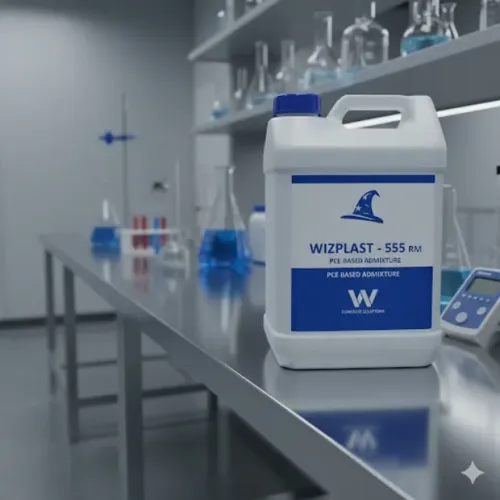
Confirm the manufacturer’s technical data sheet because concentration and density differ. Wizplast Chemicals Pvt. Ltd. should provide the product dosage range and compatibility guidance for the proposed cementitious materials.
| Option | Selection focus | What to verify |
|---|---|---|
| Short pumping distance, moderate slump | Type A | Water reduction and finishability |
| Long pumping distance or congested reinforcement | Type F; add a viscosity-modifying admixture for self-consolidating concrete | Stable flow, pump pressure and no segregation |
| Hot concrete or extended delivery | Type D or G | Slump-retention period, setting time and finishing window |
| Cold conditions or fast stripping | Type E or an accelerator | Early strength without flash set |
Trial the selected dosage at the expected concrete temperature, mixing energy, pumping distance and maximum delivery time. Record slump, air content, bleeding, setting and strength; never add site water to recover lost slump. Adjust dosage only after the trial shows the target slump and retention without delayed set or a sticky finish.
Related products
 | CONCRETE ADMIXTURE WIZPLAST - 8427 WZ is a high-performance concrete admixture developed by Wizplast Chemicals Pvt. View product → |
 | CONCRETE ADMIXTURE WIZPLAST-5736 SP is a high-performance superplasticizer admixture specially formulated by Wizplast Chemicals Pvt. Ltd. View product → |
How to run a trial mix that proves water reduction and compatibility
A trial batch proves water reduction when the treated concrete reaches the control mix’s target slump with less water, not when it simply looks looser. Use the project’s cement type, aggregates, fly ash, GGBS, silica fume and every other admixture, then keep batch size, mixing energy, sequence, concrete temperature and test timing consistent.
| Record or compare | Control batch | Admixture trial batch |
|---|---|---|
| Water and dosage | Water content and no chemical admixture | Water content plus trial batch dosage in litres or kilograms per 100 kilograms of cementitious material |
| Fresh properties | Slump or flow, air content, temperature, bleeding and segregation | The same tests at discharge and after the required transport or retention period |
| Setting and placement | Initial and final setting, pumpability and finishability | Setting shift, pressure or blockage, surface closing and finishing behaviour |
| Hardened performance | Compressive strength at specified ages | Strength at the same ages and curing conditions |
Calculate the water reduction and water-to-cementitious-materials ratio from the measured batch weights. Do not claim compatibility from one early slump reading: cement alkali and sulfate balance, supplementary cementitious materials, temperature and admixture order can change retention.
Record the following before approving the dosage:
- Batch start and discharge times, concrete temperature and ambient temperature.
- Cementitious material source, proportions and moisture corrections.
- Admixture product, batch number, dosage, dilution and point of entry.
- Slump or flow, air, setting, bleeding, strength and visible segregation.
- Results from a full-scale trial covering batching, delivery and placement time.
ASTM C494/C494M Type A, D, F or G classification supports standard performance comparisons; it does not replace this project-specific trial.
What low or high dosage does to slump, strength and finishing
A successful admixture gives the target slump while the concrete remains cohesive, stable and easy to finish. A loose mix shows a high slump but loses its aggregate structure; a good mix flows under placement energy, then holds a uniform mortar film without segregation or excessive bleeding.
- Low dosage: The slump increase is small or disappears quickly, producing rapid slump loss before discharge. If workers add site water to recover workability, the water-cementitious-materials ratio rises and strength and durability fall.
- Trial-batch dosage: Concrete reaches the specified slump with reduced water, stays cohesive during mixing and pumping, and finishes without tearing, excessive stickiness or a watery surface. Strength results must meet the project target at the tested water-cementitious-materials ratio.
- High dosage: Excessive slump can bring segregation, bleeding, entrained air, delayed setting and a weak, paste-rich surface. The concrete may look fluid but remain difficult to screed, bull-float or close because bleed water returns during finishing.
Check the mix at discharge and again after the required retention period, not only immediately after mixing. Record slump, air content, concrete temperature, time to initial set and bleeding; inspect whether coarse aggregate settles and whether the surface accepts finishing without laitance.
Rapid slump loss points to dosage, compatibility or temperature problems, not permission to add uncontrolled water.
A successful result is repeatable across trial batches and produces the specified strength after curing. Higher slump alone proves very little.
How admixtures contribute to durability without replacing concrete quality control
The finished concrete—not the admixture label—proves durability. Compare trial and control batches using the same cementitious materials, aggregate, water, temperature and curing, then verify these results:
| Performance check | Evidence of improvement | Warning sign |
|---|---|---|
| Air content and void system | ASTM C231 or C173 confirms target air; ASTM C457 examines void spacing for freeze-thaw resistance | Excess air lowers compressive strength and can signal poor consolidation or incompatibility |
| Setting time | ASTM C403 confirms the intended acceleration or delay | A retarder that leaves concrete unfinishable, or an accelerator that causes flash set, creates defects |
| Permeability and absorption | ASTM C1202, ASTM C1585 or ASTM C642 shows lower ionic penetration or water uptake | An integral waterproofing admixture cannot seal cracks, honeycombing or leaking joints |
| Strength and durability | ASTM C39 results at specified ages, plus ASTM C666 where freeze-thaw exposure applies | Extra site water can erase the admixture’s water-reduction benefit |
| Shrinkage | ASTM C157 compares drying-shrinkage length change with the control | A shrinkage-reducing admixture does not replace curing, joints, reinforcement or crack-width control |
Use an air-entraining admixture only with a measured air target. Calculate chloride from every ingredient before choosing between calcium-chloride and non-chloride accelerators where steel is exposed. Check the retarder at the expected concrete temperature and delivery time.
Qualification under ASTM C494 is not project approval. Trial batches must also record slump retention, bleeding, finishability and early strength. Use curing, consolidation, cover and joint detailing to protect the result.
Frequently asked questions
How do admixtures improve concrete workability without adding water?
Water-reducing admixtures disperse flocculated cement particles, releasing trapped mixing water and increasing paste lubrication.
How do you choose admixture dosage and type for placement conditions?
Select the admixture for the required slump retention, setting control and temperature, then confirm the dosage through a representative trial mix.
What should a concrete admixture trial mix prove?
Compare slump, water content, setting behaviour, finishing, air content and compressive strength against the approved reference mix.
What happens when admixture dosage is too low or too high?
A low dosage may leave concrete stiff and water-demanding; a high dosage can cause excessive slump, delayed setting, segregation or finishing problems.
Can admixtures replace concrete quality control?
No. Admixtures support workability, strength development and durability, but batching accuracy, curing, placement and testing remain essential.
Related products
 | CONCRETE ADMIXTURE WIZPLAST - 1315 UT is a premium-grade concrete admixture developed by Wizplast Chemicals Pvt. View product → |
 | PCE Based Admixture developed by Wizplast Chemicals Pvt. Ltd., is a high-performance PCE (Polycarboxylate Ether) based concrete admixture designed to enhance the quality... View product → |
 | PCE Based Admixture WIZPLAST - 833 SC is a high-performance PCE (Polycarboxylate Ether) based admixture, specially formulated to enhance the workability, durability, and... View product → |
 | PCE Based Admixture WIZPLAST-435 PN is a high-performance PCE (Polycarboxylate Ether) based concrete admixture designed to enhance the workability and durability of... View product → |