

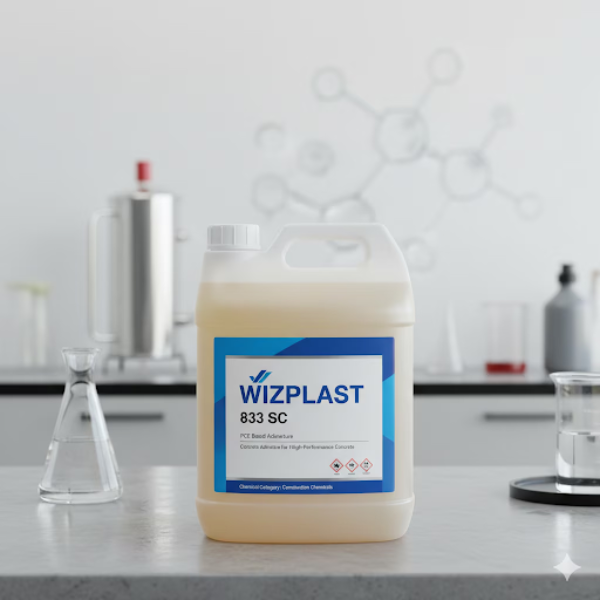
As concrete specifications become more demanding, mix designers increasingly need high workability without excessive water addition. A PCE based admixture is commonly evaluated for advanced concrete applications because polycarboxylate ether technology can provide strong water reduction and useful workability characteristics.
For ready-mix concrete manufacturers, infrastructure companies, and high-rise contractors, the decision to use PCE chemistry should still be based on actual mix performance rather than assumptions.
What Makes PCE Technology Different
PCE admixtures work through a dispersion mechanism that helps cement particles remain separated within the concrete mix. This can improve fluidity while reducing the amount of water needed to achieve the target workability.
Depending on formulation and compatibility, PCE technology may support:
- Significant water reduction
- High initial workability
- Improved slump retention
- Pumpable concrete
- Dense reinforcement placement
- High-strength mix development
- Self-compacting concrete applications
- Optimised cementitious systems
Different PCE formulations can be designed to emphasize initial slump, retention, water reduction, or combinations of these characteristics.
PCE Performance Depends on Compatibility
One of the biggest mistakes in admixture selection is assuming that the same dosage will perform identically with every cement.
Cement chemistry, supplementary cementitious materials, fine content, aggregate characteristics, temperature, and water quality can all influence behaviour.
A PCE product that performs well in one concrete plant may require dosage adjustment when the cement source changes.
Laboratory trials should therefore establish a workable dosage range before large-scale production begins.
Compare Performance at Equal Conditions
When evaluating different admixtures, comparisons should be made under controlled conditions.
Use the same cement, aggregates, water content, mixing sequence, and testing method. Measure relevant properties such as initial slump, slump after defined intervals, setting behaviour, compressive strength, and concrete appearance.
Cost should then be considered in relation to performance.
A lower price per kilogram does not necessarily produce the lowest cost per cubic metre if the required dosage is significantly higher.
Applications Can Influence Selection
A high-rise pumping application may prioritize workability retention and pumpability. Precast production may place greater emphasis on early strength development. Infrastructure concrete may have different placement and durability considerations.
In Navi Mumbai, dense urban development and large concrete pours can also make delivery time and pumping conditions important factors in admixture selection.
Wizplast Chemicals Pvt. Ltd. supplies construction chemical solutions for concrete applications where these variables need technical consideration.
Trial Mixes Reduce Procurement Risk
Procurement teams can benefit from involving technical staff before finalizing admixture supply.
Rather than comparing products only through quotations, ask for technical data and conduct representative trials. Assess dosage efficiency, workability retention, concrete stability, setting characteristics, and hardened performance.
A PCE based admixture can be highly effective in sophisticated concrete mix designs, but its value comes from compatibility with the complete concrete system. Testing under project-specific conditions gives engineers a far stronger basis for selection than product category alone.