A waterproofing supplier must match the product, evidence, delivery plan and site support to the way water will reach your structure. By the end, you will have a practical process for screening suppliers, testing their claims, comparing total installed cost and documenting the choice.
Key takeaways
- Define whether you face positive pressure, negative pressure, vapour, cracks or liquid ingress.
- Ask for test reports, technical data, batch traceability and a project-specific trial.
- Compare total installed cost, including preparation, labour, wastage, rework and delivery risk.
- Score installation guidance and after-sales support before choosing a supplier.
Define the Waterproofing Performance Your Project Actually Needs
Start waterproofing supplier selection by naming the exposure: positive hydrostatic pressure, negative-side pressure, intermittent dampness, vapour transmission, or liquid-water penetration through cracks and joints. Then state the function: prevent ingress in new concrete, seal cracks and joints, coat a surface, cure concrete, or repair an already leaking structure.
Damp-proofing is not automatically suitable for below-grade water pressure.
Give the supplier measurable site information:
- Crack width and whether movement is static or cyclic; substrate moisture and water source.
- Application temperature, curing regime, traffic, backfilling, UV, abrasion and impact exposure.
- Chemical name, concentration, temperature, exposure duration and whether contact is continuous or intermittent.
- Concrete mix, plaster, reinforcement, existing coating and other admixtures requiring compatibility.
For a liquid membrane, request crack-bridging results under ASTM C1305, with crack width, temperature, ageing and movement conditions stated. Ask whether the complete system handles the actual substrate and construction details, not only a laboratory panel.
Do not accept a surface coating for negative-side waterproofing, an integral admixture to repair active cracks, or a curing compound where a later bonded coating or screed must adhere. Integral admixtures cannot correct honeycombing, poorly detailed joints, penetrations or uncontrolled cracking. Negative-side waterproofing requires a system qualified for water pressure acting behind the treated surface.
Demand Documents, Test Evidence and a Project-Specific Trial
1. Approve the product only after the supplier submits a current technical data sheet, safety data sheet, certificate of analysis, batch number, manufacturing date, shelf life, storage instructions and application method. Reject documents with an expired revision, missing lot identification or instructions that do not match the proposed use.
2. Match every test report to the standard named in your specification: IS 2645 waterproofing compound testing, IS 9103, ASTM C494 or EN 934-2. ASTM C494 demonstrates effects such as water reduction, setting time and strength; it does not prove watertight concrete. Require project criteria for permeability, absorption, crack control, watertightness and strength.
3. Require a trial mix using the project’s cement, supplementary cementitious materials, aggregates, water and other admixtures. Record dosage, workability, setting, strength and water-penetration results. For coatings, define wet- or dry-film thickness, coverage, coat count, recoat window and curing conditions.
Where adhesion matters, specify ASTM C1583, the minimum value, test locations, curing age and acceptable failure mode.
4. State the allowable substrate-moisture limit and test method: ASTM F2170, ASTM F1869 or ASTM D4263. High moisture can cause blistering or debonding beneath low-permeance coatings. Use retained samples, third-party testing and a site mock-up to verify batch consistency, and link installed areas to batch numbers rather than accepting claims such as “premium” or “advanced.”
Compare Supplier Type, Traceability and Supply Reliability
Choose the supplier that can remain accountable from batch release through site acceptance, not simply the one closest to site.
| Supplier type | Stock ownership and storage | Certificate and failed-batch responsibility |
|---|---|---|
| Waterproofing chemical manufacturer | Owns stock and controls factory release; storage after dispatch must be defined | Issues the certificate of analysis and leads investigation, replacement or corrective action |
| Authorised distributor | Owns or holds allocated stock under agreed storage controls | Obtains manufacturer documents and coordinates claims under its authorisation |
| Wholesaler | May source mixed inventory; verify warehouse conditions and stock rotation | Must identify the issuing manufacturer and confirm who handles rejection |
| Local reseller | May provide rapid delivery but storage and provenance need proof | Escalation, warranty authority and formulation support may be limited |
Treat authorised distributor versus reseller as a traceability decision, not a label. Require batch traceability from every delivery to the manufacturer, batch number, manufacturing date and lot allocation. Confirm that required lots can be reserved without mixing unapproved batches.
Record these supply checks:
- Stock rotation, minimum order quantity, lead time, partial-delivery capability and emergency replenishment
- Controls for damaged bags, leaking drums, unreadable labels and short remaining shelf life
- Manufacturing capacity, alternate raw-material sources, quality-system controls and construction chemical supply continuity
Name the person who approves method statements, attends site trials and escalates nonconformance. Keep each answer and its evidence; locality and claims of serving large projects do not prove reliability.
Test the Supplier’s Installation and After-Sales Support
1. Require a project-specific waterproofing method statement before delivery. It must specify substrate preparation, cleaning, repairs, primer, reinforcement mesh, mixing sequence, dilution ratio, equipment, material, air and substrate temperature limits, dew-point margin, coat thickness, pot life and recoat interval, curing time, rain protection and inspection before concealment.
2. Ask for measurable installation controls: dosage per kilogram of cement or per cubic metre of concrete, coverage per litre or kilogram, and dosage changes linked to cement type or water-cement ratio. For liquid membranes, require batch-linked records for area, coverage, wet- or dry-film thickness, coats, curing and losses from porous or rough substrates.
3. Confirm waterproofing site support in writing. The commitment should name a toolbox briefing, site visit, mock-up approval, troubleshooting process and response time for nonconformance. For exposed or trafficable areas, require a tested protection and wearing system covering UV, abrasion, impact, backfilling and construction traffic.
4. Demand compatible details for joints, corners, drains, pipe penetrations, terminations and material transitions. The supplier must identify approved combinations of sealants, waterstops, primers, reinforcement and protection boards, then assign responsibility for preparation, detailing, protection, inspection and repairs.
5. Read the waterproofing warranty exclusions line by line. Establish whether failure coverage means product replacement only or includes removal and reapplication, and record exclusions for substrate movement, workmanship, ponding water and failure to follow the approved method statement. Reject vague commitments that leave inspection and repair responsibility undefined.
Use a Weighted Scorecard Based on Total Installed Cost
A strong waterproofing supplier scorecard ranks performance evidence and execution risk before price. Build it before requesting final quotations, then use this supplier comparison checklist:
| Criterion | Weight | Evidence required |
|---|---|---|
| Technical fit | 20% | Project compatibility statement and approved mock-up |
| Evidence and testing | 15% | Current test report against the specified standard |
| Batch consistency | 15% | Retained-sample plan and certificate of analysis |
| Delivery capacity | 15% | Lot allocation and dated delivery schedule |
| Technical support | 15% | Named technical contact and site-support commitment |
| Warranty terms | 10% | Written warranty clause defining responsibility and remedies |
| Commercial value | 10% | Itemised quotation using the same dosage and yield basis |
Calculate total installed cost waterproofing, not the drum or bag price. Include:
- Surface preparation, primer and reinforcement mesh
- Extra coats, curing, labour and application equipment
- Wastage, testing, protection, rework and project downtime
A cheaper bag becomes the expensive option when porous concrete reduces coverage or repeated repairs follow poor detailing. Require each quotation to state dosage, mixing sequence, coverage or expected yield, coat thickness and curing assumptions.
Wizplast Chemicals Pvt. Ltd. belongs in the comparison only when its documents, project compatibility, delivery plan and support commitments meet the same evidence standard as every rival. Approve the winner after the quotation, trial results, method statement, inspection plan and warranty define responsibilities and the remedy when acceptance criteria are missed.
Related products
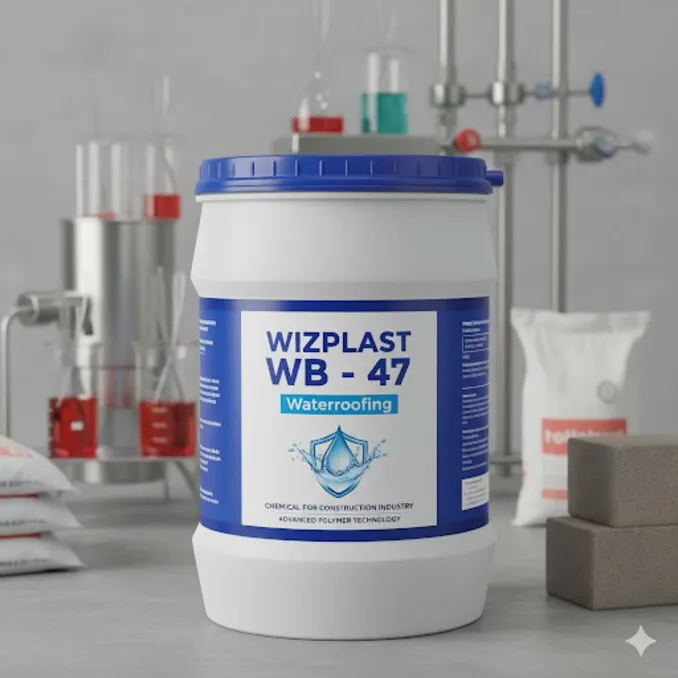
 | Waterproofing WIZPLAST WB-47 is a premium-grade water-based waterproofing solution developed by Wizplast Chemicals Pvt. View product → |
 | Waterproofing WIZCOAT WP-2 by Wizplast Chemicals Pvt. Ltd. is a high-performance waterproofing compound specially formulated to provide long-lasting protection... View product → |
Frequently asked questions
What waterproofing performance should you define before choosing a supplier?
Identify the exposure first: positive hydrostatic pressure, negative-side pressure, intermittent dampness, vapour transmission, or liquid-water penetration through cracks and joints. Then specify whether you need ingress prevention, crack or joint sealing, surface coating, concrete curing, or repair of a leaking structure.
Which documents and tests should you request from a waterproofing chemical supplier?
Request the technical data sheet, safety data sheet, certificate of analysis, batch number, shelf-life details, application instructions and relevant test reports. Confirm that the evidence matches the product, substrate, exposure and intended use, then run a project-specific trial.
How can you compare waterproofing suppliers beyond product price?
Compare manufacturer or wholesaler capability, batch traceability, stock availability, delivery reliability, minimum order requirements and replacement procedures. Include preparation, labour, wastage, equipment, curing time, rework and failure risk in the total installed cost.
What installation and after-sales support should a supplier provide?
Check whether the supplier gives substrate-preparation instructions, mixing ratios, coverage calculations, application limits, joint and crack details, curing requirements and site troubleshooting. Ask who will attend a failed trial or application problem and how quickly they respond.
Related products
 | Waterproofing WIZPLAST IW‐344 is a premium integral waterproofing compound developed by Wizplast Chemicals Pvt. Ltd. View product → |
 | Waterproofing by Wizplast Chemicals Pvt. Ltd. is an advanced acrylic-based waterproofing coating specially designed to protect surfaces from water seepage,... View product → |
 | Waterproofing WIZPLAST SHORTCRETE is an advanced waterproofing solution developed by Wizplast Chemicals Pvt. View product → |
 | Waterproofing Wizplast Chemicals Pvt. Ltd. offers premium-quality Curing Compounds and Sealants designed to deliver superior waterproofing and surface protection... View product → |