
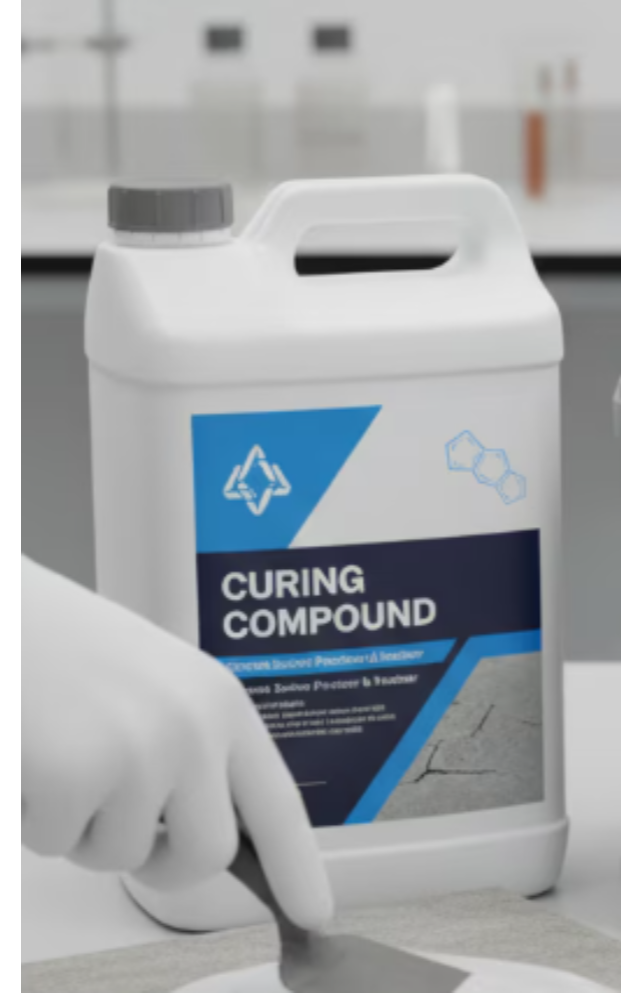
Concrete does not complete its development when finishing work ends. The period immediately after placement is critical because sufficient moisture must remain available for cement hydration. A Curing Compound provides a practical method of limiting moisture loss from exposed concrete surfaces when conventional water curing is difficult to maintain.
Understanding how curing compounds work helps engineers and contractors decide where this method fits within their construction programme.
Why Fresh Concrete Needs Moisture Protection
After concrete has been placed, water within the mix participates in the hydration process. When surface moisture evaporates too quickly, particularly under warm, dry, or windy conditions, proper curing can become difficult.
Rapid moisture loss can contribute to surface-related problems and may interfere with the intended development of concrete properties.
Traditional curing methods include ponding, wet coverings, sprinkling, and continuous water application. These methods can be effective, but they require water availability, labour, access, and ongoing supervision.
A curing compound takes a different approach.
Once applied to an appropriate concrete surface, it forms a membrane that helps reduce moisture evaporation. The purpose is to retain more of the concrete's internal moisture during the curing period.
Applications Where Curing Compounds Can Be Useful
Large exposed surfaces can make continuous wet curing labour-intensive. This is one reason curing compounds are considered for applications such as:
- Industrial flooring
- Concrete roads
- Pavements
- Bridge decks
- Parking areas
- Warehouses
- Large slabs
- Infrastructure structures
- Certain precast applications
Projects throughout Navi Mumbai and Maharashtra may also face periods of high temperature and strong sunlight, making timely curing planning especially important.
Application Quality Matters
Even a suitable compound cannot compensate for poor application.
Coverage needs to be reasonably uniform so that the intended membrane forms across the treated surface. Application timing also matters. Applying the material at an unsuitable stage can reduce effectiveness.
Project teams should follow the manufacturer's technical instructions concerning surface condition, application rate, equipment, number of coats, and drying requirements.
Areas that receive too little material can allow greater moisture escape, while uncontrolled overapplication may create unnecessary material consumption and potentially affect later surface treatments.
Check Compatibility With Later Finishes
One practical issue sometimes overlooked is what happens to the concrete surface after curing.
If a floor will later receive an epoxy coating, adhesive, waterproofing layer, screed, paint, or another bonded finish, the curing membrane may need to be removed or assessed for compatibility.
This should be considered before product selection rather than after finishing work begins.
Curing Is Part of Concrete Quality Management
Curing compounds should be viewed within a wider concrete quality plan that includes proper mix design, placement, compaction, finishing, joint planning, and protection.
Wizplast Chemicals Pvt. Ltd. supplies construction chemical solutions relevant to concrete applications, including projects where practical curing methods need to be evaluated against site requirements.
For contractors and infrastructure teams in Navi Mumbai, selecting a Curing Compound based on application conditions, expected coverage, surface requirements, and subsequent finishing work can make curing management more systematic.
Good concrete curing is ultimately about controlling conditions during a critical stage of concrete development. A suitable compound, correctly applied, provides one practical way to achieve that objective when continuous water-based curing is difficult to execute.